If there’s one thing I’ve learned from walking through hundreds of homes with clients, it’s that clutter doesn’t just take up space; it takes up attention. The moment a buyer steps through the door, they’re already making decisions. Not consciously, but emotionally. And what they feel in the first sixty seconds of a viewing often determines whether they come back for a second one.
I’ve sat with sellers who’ve spent years (sometimes decades) in a home. It’s full of life, full of memories, full of things that made perfect sense when they moved in. But what works for living doesn’t always work for selling. And that gap, between how you see your home and how a buyer sees it, is exactly what this list is for.
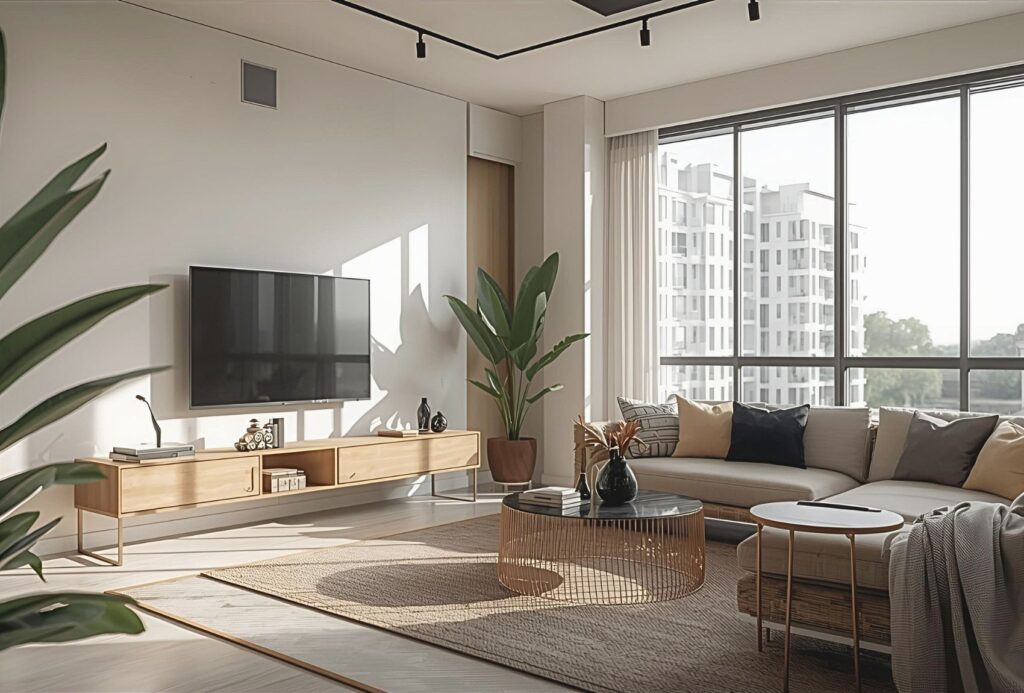
This isn’t about making your home look like a showroom. It’s about removing the noise so buyers can actually see what they’re buying. You don’t have to throw everything away. Some things just need to be packed, stored, or moved out temporarily, but the ones that stay should earn their place.
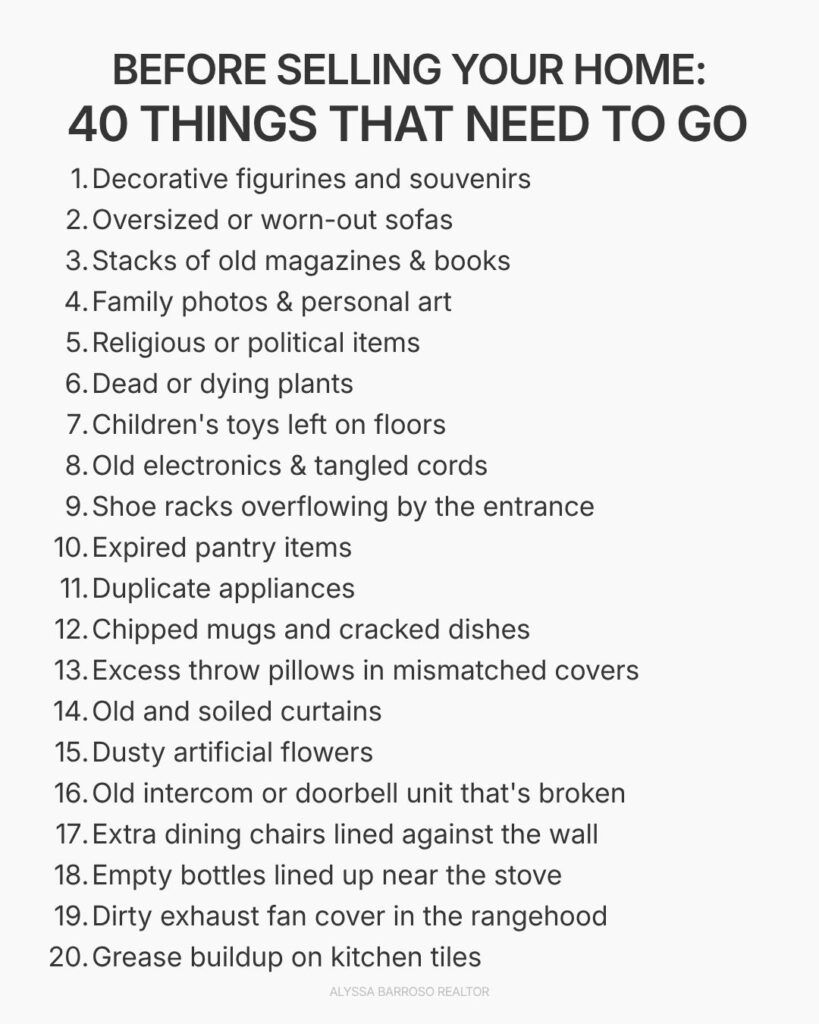
1. Decorative figurines and souvenirs
The ones from Tagaytay, the ones from your trip abroad, the little ceramic knick-knack from a friend’s wedding? They all mean something to you. But to a buyer, they’re just visual noise that makes surfaces feel busy, and the room feel smaller.
2. Oversized or worn-out sofas
A sofa that’s seen ten years of telenovelas and Sunday afternoons might still be comfortable, but if it dominates the living room or shows its age, it’s the first thing buyers notice and not in a good way. A room that feels tight because of one piece of furniture is a room that feels small on paper, even when it isn’t.
3. Stacks of old magazines and books
A few books styled on a shelf look intentional. A tower of Reader’s Digests from 2011 on the coffee table does not. If you haven’t read it in the last couple of years, it’s not decor, it’s clutter.
4. Family photos and personal art
This one may sting a little, but buyers need to imagine their family in your home, not feel like guests in yours. Pack the photos away; they’ll go back up in your next home.
5. Religious or political items
Faith is personal. Politics is personal. Your buyer may not share either, and the last thing you want is for something on your wall to create a feeling (even a subtle one) that this home isn’t for them.
6. Dead or dying plants
Nothing says “neglected” like a brown plant in a corner. If it’s not thriving, it goes. Buyers read the condition of your plants the same way they read the condition of everything else.
7. Children’s toys left on floors
A home with kids is a lived-in home, and there’s nothing wrong with that. But toys on the floor during a viewing make spaces feel chaotic and harder to inhabit mentally. Pack them into bins, store them in a room, or move them out entirely for the day.
8. Old electronics and tangled cords
That old DVD player nobody uses, the cords behind the TV that look like a fire hazard – buyers notice these things. They make a home feel dated and unmaintained, even when everything else is fine.
READ: What You Need to Know About Staging Your Home
9. Shoe racks overflowing by the entrance
The entrance sets the tone for the entire viewing. An overflowing shoe rack is the first thing a buyer sees and it immediately signals: this home doesn’t have enough storage. Even if it does.
10. Expired pantry items
Buyers open cabinets. They just do. And a pantry full of expired goods reads as disorganized, which makes them wonder what else in the home hasn’t been looked after.
11. Duplicate appliances
Two rice cookers. Two ref units. An extra microwave on the counter. Having backups makes sense for a family, but for a viewing it makes the kitchen feel crowded and the storage look insufficient.
12. Chipped mugs and cracked dishes
If you wouldn’t serve a guest with it, don’t leave it in the cabinet during a viewing. Pack the damaged ones away and let what’s left look intentional.
13. Excess throw pillows in mismatched covers
There’s a version of throw pillows that adds warmth to a room. Then there’s the version where every sofa cushion has a different cover and half of them are lumpy. The second version goes.
14. Old and soiled curtains
Curtains affect light, and light affects everything. Old, heavy, or stained curtains make rooms feel darker and smaller. If you can’t replace them before the viewing, at least have them cleaned.
15. Dusty artificial flowers
Artificial flowers had a moment. That moment has passed. Dusty ones, especially, are one of those details buyers clock without even meaning to, and it lingers.
16. Old intercom or doorbell unit that’s clearly broken
A broken intercom by the gate or at the door is a small thing, but small things add up. Buyers are already doing math in their heads on what needs fixing or what needs replacing. Don’t give them more to add.
17. Extra dining chairs lined against the wall
When there’s no room for the chairs at the table, they end up against the wall. It makes the dining area feel like it can’t accommodate the furniture that came with it which is exactly the wrong message.
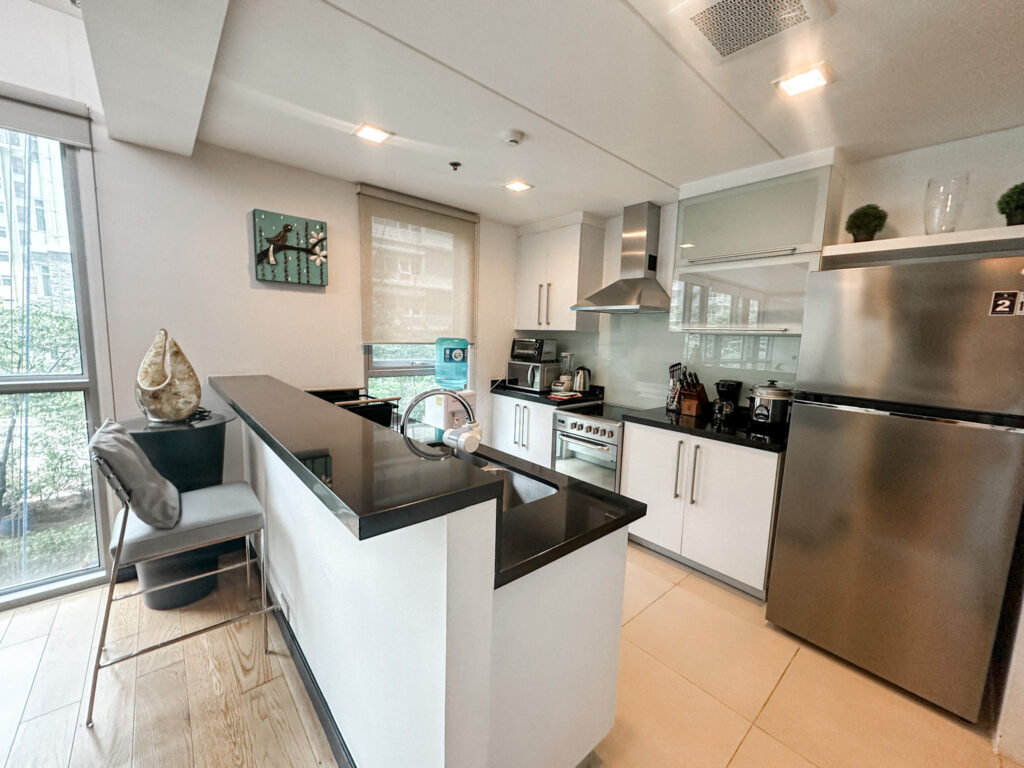
18. Empty bottles lined up near the stove
Cooking oil bottles, condiment containers, and soy sauce that’s almost done are lined up near the stove; they look like a collection, not a kitchen. Clear the counter. Let the stove be the focus.
19. Dirty exhaust fan cover in the rangehood
Buyers look up. They look inside things. A grease-caked rangehood cover reads as a kitchen that hasn’t been properly cleaned, which makes them wonder about the rest of the home.
20. Grease buildup on kitchen tiles
The tiles behind the stove take a normal beating. But for a viewing, they need to be clean. It’s the kind of thing that’s easy to miss when you’re used to the space and impossible to miss when you’re seeing it for the first time.
READ: Things Sellers Must Do to Sell a Property
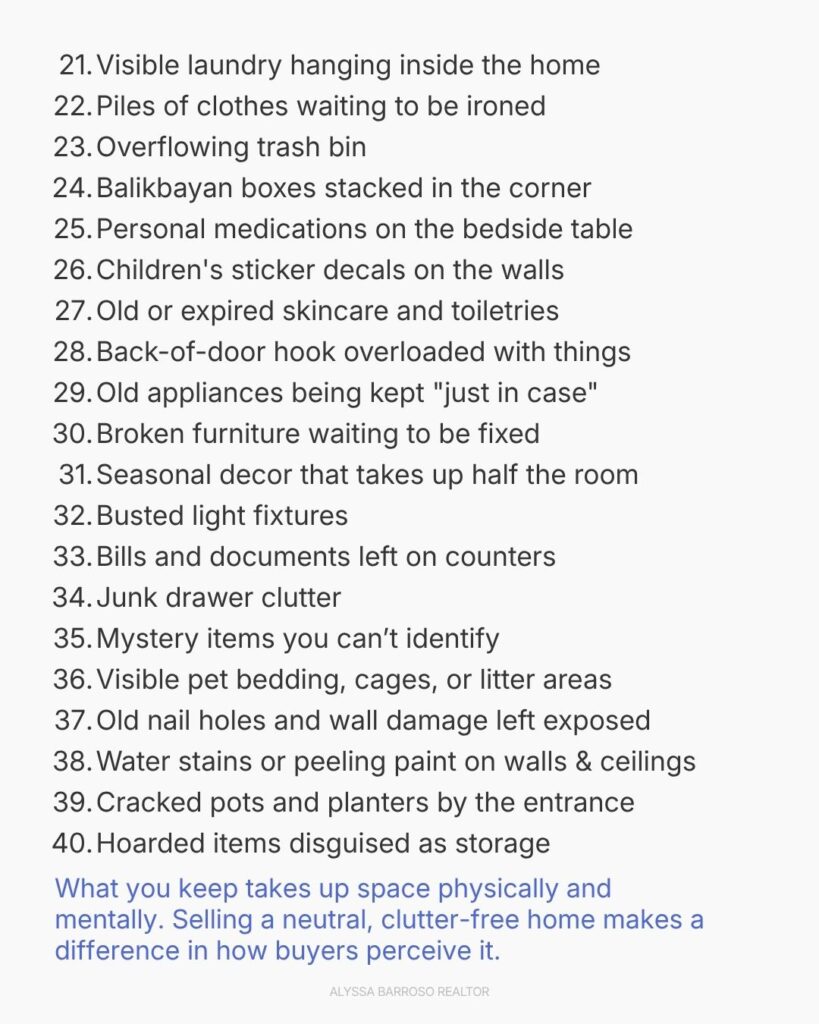
21. Visible laundry hanging inside the home
It’s understandable that in many homes, the laundry area is inside, and that’s fine. But for a viewing, no laundry should be visible, not even in the utility area. It makes the home feel like it’s mid-routine, not ready to be seen.
22. Piles of clothes waiting to be ironed
Same principle. A pile of clothes on the ironing board or stacked on a chair is an unfinished task that buyers walk past. It pulls their attention and breaks the mental image of a home that’s well-kept.
23. Overflowing trash bin
Empty every bin in the house before a viewing. Every single one. This should go without saying, but it doesn’t always happen, and it only takes one full bin to change the feeling of an entire room.
24. Balikbayan boxes stacked in the corner
They’re part of life in many Filipino homes, but a stack of balikbayan boxes in the bedroom or living area reads as temporary, like the home is mid-move. Which, technically, it will be, but buyers don’t need to see that yet.
25. Personal medications on the bedside table
Health is private. Medications left in plain view during a viewing are an overshare and they remind buyers that this is someone else’s very personal space, which is the opposite of what you want them to feel.
26. Children’s sticker decals on the walls
They were cute when your kids were five. Now they’re just something a buyer has to mentally paint over and everything they have to mentally fix is a thing that can subconsciously lower their offer.
27. Old or expired skincare and toiletries
Bathroom counters are some of the most personal surfaces in a home. Clear them completely. What’s left should look like a hotel counter: minimal, clean, and neutral.
28. Back-of-door hook overloaded with things
Robes, bags, belts, scarves – the back-of-door hook accumulates everything. For a viewing, it should either be empty or have one or two things hanging neatly. The overloaded version makes the room feel like it has no storage.
29. Old appliances being kept “just in case”
The broken blender you’re going to get repaired. The electric fan missing a blade. The rice cooker that still technically works but you never use. If a “just in case” has been in your storage room for three years, it can go.
30. Broken furniture waiting to be fixed
If it’s been waiting to be fixed since before you decided to sell, it’s not getting fixed. Move it out. Broken furniture is one of those things buyers photograph on their phones and show other people as a reason to negotiate.
READ: Getting Ready for Showings: Simple Habits That Make Buyers Stay Longer
31. Seasonal decor that takes up half the room
Christmas decor, Halloween props, and birthday backdrops that are not in season shouldn’t be visible. A room that has to share space with stored seasonal items feels like it lacks storage, even when the items themselves are the problem.
32. Busted light fixtures
A room is only as good as its light. A broken fixture (even one) tells buyers the home hasn’t been looked after. Replace the bulb, fix the fitting, or remove the fixture entirely. Dark rooms don’t sell.
33. Bills and documents left on counters
Beyond the privacy issue, papers on counters make kitchens and work areas feel messy and lived-in in the wrong way. Clear them before every viewing, not just the first one.
34. Junk drawer clutter
Buyers open drawers. We’ve seen it happen, and seeing clutter diverts their focus. The junk drawer is fine to have as long as it looks like organized junk, not a decade of accumulated chaos.
35. Mystery items you can’t identify
If you can’t remember where it came from or what it does, it definitely has no business being in a home you’re trying to sell. If you can’t identify it, neither can a buyer, and that’s just a distraction you don’t need.
36. Visible pet bedding, cages, or litter areas
Pets are family. But not every buyer shares that feeling, and some are genuinely put off by visible signs of animals in the home. Move pet areas out of sight for viewings, and make sure there’s no lingering smell because that one matters more than almost anything on this list.
37. Old nail holes and wall damage left exposed
A nail hole is a five-minute fix with some putty and paint. Left exposed, it reads as neglect. Buyers will find every one of them and add it to their mental list of things that need attention.
READ: 30 Survival Tips for Homeowners
38. Water stains or peeling paint on walls and ceilings
Water stains trigger one question in every buyer’s mind: is there still a leak? Even if it’s been fixed, an untreated stain suggests it hasn’t been. Paint over it. It’s worth the cost.
39. Cracked pots and planters by the entrance
The entrance is the first impression and the last one; buyers see it when they arrive and when they leave. Cracked or weathered pots make an otherwise nice frontage look unmaintained. Replace them or remove them.
40. Hoarded items disguised as storage
Every home has a version of this: the room, the corner, the cabinet that became a holding area for things that were never really put away. Buyers see through it immediately. If it’s been sitting there untouched, it’s not storage. It’s a decision you’ve been putting off. Make it before the viewing.
Remember, what you keep takes up space physically and mentally. I’ve walked through homes where everything looked right on paper (e.g., good location, generous floor area, well-priced) and watched buyers hesitate because the space felt heavy with someone else’s life. Decluttering doesn’t erase the fact that you spent time and care in a home. But it gives the next owner room to imagine theirs. A neutral, clutter-free home is simply easier to sell. And in my experience, it also feels better to leave.