
The Philippines has a way of making people consider staying a little longer.
For some, it starts with a holiday. For others, it may be the country’s climate, its food and culture, the ease of communicating in English, or simply the familiarity and warmth that make returning feel increasingly natural. Over time, the idea of having a home here can become less of a daydream and more of a practical consideration.
And once buying property becomes a serious possibility, the questions become more practical: What can a foreigner actually own? Which type of property makes sense? What costs are involved? How does the buying process work, particularly if you’re purchasing from overseas?
The Philippines has become an increasingly interesting market for international buyers, and purchasing property here comes with rules and considerations that are important to understand before making a commitment.
This guide covers the practical basics foreign buyers should know before, during, and after purchasing residential property in the Philippines—from ownership restrictions and choosing the right property to transaction costs and what to consider after the purchase.
Whether you’re already living in the Philippines, visiting regularly, planning a move, or simply exploring the possibility of buying here, this is a good place to start.
Important: Philippine property ownership rules are unique and may vary based on citizenship, property type, and the structure of the transaction. This article is intended as a practical real estate guide, not legal or financial advice. For any specific transaction, we highly recommend working closely with a licensed professional.
Table of Contents
PRE-PURCHASE
- Can Foreigners Own Property in the Philippines?
- What Does a Foreigner Actually Own When Buying a Condo?
- Can a Foreigner Buy a House in the Philippines?
- What About Buying Land Through a Philippine Corporation?
- Do You Need an Expert — Agent or Lawyer?
- Can Foreigners Get a Visa for Property Purchase?
- What Real Estate Expenses Are Involved?
- Where Do Foreign Buyers Commonly Look?
PURCHASING PROPERTY
- What Is the Process for Buying Property in the Philippines?
- Can Foreigners Get a Philippine Home Loan?
- Pre-Selling vs. Completed Properties
AFTER BUYING
- What If You Plan to Rent Out Your Property?
- What Are the Ongoing Costs of Ownership?
- Selling a Property Down the Line
EXPLORE
PRE-PURCHASE

Can foreigners own property in the Philippines?
Yes, but there are important restrictions.
Foreigners may own certain types of real property in the Philippines, including condominium units, but they generally cannot directly own private land.
This distinction is important because “property” can mean very different things. A condominium unit, a house and lot, a vacant residential lot, and a building constructed on leased land do not all follow the same ownership rules.
The Condominium Act of the Philippines (RA 4726) allows foreigners to acquire condominium units, subject to the ownership limitations applicable to the condominium project. The law generally limits foreign participation in a condominium project to no more than 40%, which is why the commonly cited “40% foreign ownership rule” comes up whenever a foreign buyer purchases a condominium.
Foreigners may also own buildings and other improvements even where they cannot own the underlying land.
This is one reason some residential properties in the Philippines are structured differently from the typical house-and-lot arrangement familiar to buyers in other countries.
For a foreign buyer, the first question should therefore be: “What exactly am I buying?“
What does a foreigner actually own when buying a condo?
When you purchase a condominium, you are acquiring ownership of the individual unit together with the rights and interests attached to the common areas under the condominium project’s governing documents.
You are not buying the land underneath the condominium in the same way that a Filipino buying a house and lot acquires the land itself.
A foreigner may legally own a condominium unit even though the constitutional restrictions on private land ownership still apply.
The condominium project itself must also comply with the applicable nationality restrictions. Before purchasing a resale unit, it is worth confirming that the transaction will not cause the project to exceed the permitted foreign ownership threshold.
This is something that should be checked before you commit to the purchase, rather than discovered later during the transfer process.
Can a Foreigner Buy a House in the Philippines?
A foreign national generally cannot purchase a house and lot in their own name because the land itself is private land, and private land ownership is restricted to those qualified under the Philippine Constitution.
That does not mean a foreigner can never own a house or other building.
The ownership of a building or improvement can be separated from ownership of the land. The legal structure of the transaction therefore matters.
For example, a foreign buyer may have an interest in a house or other improvement under a valid legal structure, which may include a condominium arrangement, while the land remains owned by a person or entity legally qualified to own it.
This is very different from simply putting a normal house-and-lot title in a foreign buyer’s name.
If you are considering a house outside a condominium structure, have the proposed ownership arrangement reviewed by a Philippine lawyer before making a substantial payment.
What about buying land through a Philippine corporation?
You may come across the idea of setting up a Philippine corporation to purchase land.
There is a legitimate legal framework for Philippine corporations that qualify as Philippine nationals to own land. Generally, a corporation with at least 60% Filipino ownership can qualify as a Philippine corporation for purposes where nationality restrictions apply. The exact requirements depend on the applicable law and structure.
But this is not a shortcut for putting land in a corporation while secretly retaining complete foreign control.
The Filipino ownership must be genuine. Philippine jurisprudence has emphasized that merely having Filipino names on paper is not enough; beneficial ownership and the required ownership structure matter.
For that reason, foreign buyers should be extremely cautious about arrangements involving nominees, informal ownership agreements, or structures designed primarily to get around nationality restrictions.
If land ownership through a Philippine corporation is being considered, get proper legal and corporate advice before putting money into the transaction.
Do You Need an Expert – Agent or Lawyer?
Ideally, you know when you need both.
A good real estate agent and a good property lawyer do very different jobs.
Your agent helps you understand the market, identify suitable properties, compare competing listings, arrange viewings, negotiate commercial terms, and coordinate the many moving parts of the transaction.
A good agent should also tell you when a property does not make sense.
That’s particularly important for buyers overseas. You may be able to find hundreds of Philippine property listings online, but a listing does not tell you everything you need to know about the property, the building, the seller, or the transaction.
Your lawyer, on the other hand, protects your legal interests. They can review contracts, ownership structures, titles, corporate documents, and other legal matters that go beyond the role of a real estate broker.
Foreign buyers sometimes ask whether they can simply choose one professional and skip the other.
For a straightforward condominium purchase, your broker may coordinate much of the transaction. But if there are questions around nationality, corporate ownership, inheritance, unusual payment arrangements, title issues, powers of attorney, or other legal matters, bringing in a lawyer is sensible.
The two roles complement each other.
You don’t hire a lawyer because your broker isn’t capable of handling a transaction. You hire one because legal advice and real estate advice are different things.
Can Buying Property Help You Get a Visa?
Buying property in the Philippines does not automatically give a foreigner the right to live in the country indefinitely. Property ownership and immigration status are separate matters.
If your plans involve spending more time in the Philippines, there are several visa and residency options that may be relevant depending on your nationality, age, circumstances, and purpose of stay.
One option that may be relevant to retirees and other qualifying applicants is the Special Resident Retiree’s Visa (SRRV) administered by the Philippine Retirement Authority (PRA). The SRRV is designed for qualified foreign nationals and former Filipino citizens who want to live and retire in the Philippines on a long-term basis. Current eligibility and program requirements are set by the PRA and can change over time.

The important distinction for a property buyer is that the SRRV is not a property-ownership program. You do not need to buy a property to establish that you qualify for an SRRV, and buying a condominium does not automatically qualify you for one.
If you’re planning a move to the Philippines, it’s worth looking at your immigration options and your property plans separately, then considering how the two fit together.
What Real Estate Expenses are Involved?
When buying a property in the Philippines, the purchase price is only part of the total cost.
For many residential purchases, buyers will also need to prepare for taxes, transfer and registration fees, professional fees, and other transaction costs. The exact amount depends on the type of property, the seller, the transaction structure, and how the parties agree to allocate certain expenses.
For condominium purchases, ownership is evidenced by a Condominium Certificate of Title (CCT). The transfer of ownership and release of the relevant title documents will depend on the payment terms and transaction structure. In a bank-financed purchase, the process can also involve additional documentation and registration requirements.
Here are some of the more common costs to consider.
Costs commonly incurred by the SELLER:
Capital Gains Tax
For real property classified as a capital asset, the Capital Gains Tax (CGT) is generally 6% of the applicable tax base, based on the gross selling price or the property’s fair market value, whichever is higher, subject to the applicable tax rules.
This is generally a seller’s tax.
The treatment can be different when the property is classified as an ordinary asset, so buyers should not assume that the same tax treatment applies to every real estate transaction.
Value Added Tax, if applicable
Value-Added Tax (VAT) is generally 12% when applicable to a taxable sale by a VAT-registered seller, such as a developer or another seller engaged in the business of selling real property.
Not every residential property sale is subject to VAT, so this should be determined for the specific transaction.
For example, a resale condominium sold by an individual who is not engaged in the real estate business may be treated differently from a unit being sold by a developer in the ordinary course of business.
Real estate broker’s fee
If the property is being sold through a real estate broker, the seller will typically pay the broker’s professional fee according to the agreed terms of the engagement.
A commission in the range of 3% to 6% is commonly seen in the Philippine residential market, although the actual rate can vary depending on the property, transaction, brokerage arrangement, and services provided.
Costs commonly incurred by the BUYER:
Documentary Stamp Tax
Documentary Stamp Tax (DST) is imposed on certain documents and instruments involving the sale or transfer of real property.
For a deed of sale or conveyance of real property, the applicable rate is effectively 1.5%, based on the consideration or fair market value prescribed under the tax rules, whichever is higher.
Notarial fee
The Deed of Absolute Sale and other transaction documents may need to be notarized.
Notarial fees are not subject to one universal percentage of the property’s selling price, so the amount can vary depending on the document, transaction, and notary.
It is therefore better to obtain the actual fee from the notary handling the transaction rather than budgeting around a fixed percentage.
Transfer Tax
Transfer tax is imposed by the local government on the transfer of ownership of real property.
The rate depends on the property’s location. Provinces may impose a transfer tax of up to 0.5% of the applicable consideration or fair market value, while cities may impose up to twice the provincial rate, which is why buyers commonly encounter rates of up to 0.75% depending on the location.
Registration fee
Registration fees are paid to the Registry of Deeds / Land Registration Authority in connection with registering the transfer and related documents.
Unlike some of the taxes above, this should not be treated as a universal 1% charge. The applicable amount is determined under the LRA’s fee schedule and can depend on the transaction and documents being registered.
Other Costs to Keep in Mind
Depending on the transaction, a buyer may also encounter:
- Bank appraisal and processing fees
- Mortgage and registration fees if the purchase is financed
- Insurance required by the lender
- Outstanding condominium or association dues
- Real property taxes
- Legal or professional fees
- Documentary and certification expenses
- Costs related to a Special Power of Attorney if the buyer is purchasing from overseas
For a foreign buyer, there may also be practical costs associated with coordinating the transaction from abroad, particularly if documents need to be authenticated, notarized, apostilled, or signed through an authorized representative.
A Useful Guide to Transaction Costs
The following is a useful starting point, but it should not be treated as a fixed percentage or quote for every transaction.
| Transaction Cost | General Guide | Typically Paid by |
| Notarial Fee | 1% – 2% | buyer |
| Transfer Tax | 0.50% – 0.75% | buyer |
| Registration Fee | Based on LRA schedule | buyer |
| Documentary Stamp Tax | 1.50% | buyer |
| Capital Gains Tax | 6.00% | seller |
| Value Added Tax | 12.00% when applicable | seller |
| Real Estate Agent´s Fee | 3.00% – 6.00% | seller |
The allocation of certain expenses is a matter of agreement between the parties, while some taxes and fees have legally designated taxpayers or filing requirements. Your broker, lawyer, accountant, or other appropriate professional should confirm the actual costs applicable to your transaction.
For a foreign buyer, the safest approach is to ask for a complete estimate of your expected cash requirement before committing to the purchase.
The purchase price is only one number. You should also know what you will need to pay to get from an accepted offer to completed ownership.
If you have further questions about the taxes or expenses applicable to your specific transaction, you may consult with a tax lawyer or accountant.
Where Do Foreign Buyers Commonly Look?
There is no single “foreigner-friendly” location in the Philippines. The right area depends on why you’re buying.
A buyer relocating to Manila may prioritize walkability, restaurants, offices, schools, hospitals, and access to the airport.
Someone buying a second home may have very different priorities.
An investor may be more interested in rental demand, resale liquidity, building policies, and the number of competing units.
In Metro Manila, foreign buyers commonly look at established areas such as Makati, Bonifacio Global City, Rockwell, Ortigas, and Alabang, among others.
For buyers looking south of Metro Manila, the SLEX corridor offers a very different proposition, with communities in Muntinlupa, Cavite, Silang, and Laguna appealing to buyers looking for more space, access to Metro Manila, or a different pace of living.
READ: Metro South Where to Live: A Neighborhood Guide
Rather than starting with a list of “best places to buy,” start with how you intend to use the property.
- Are you moving here?
- Looking for a second home?
- Buying for rental income?
- Planning to spend only part of the year in the Philippines?
Your answer will narrow the location considerably.
RARE’s Area Guides can help you explore different markets and understand what each location offers.
PURCHASING Property

What Is the Process for Buying Property in the Philippines?
The exact process depends on the property and the seller, but a typical resale condominium transaction will involve several stages.
#1. Establish your budget
Know how much you are prepared to spend and whether you will be paying upfront or on an installment basis.
#2. Identify the right property
Your agent can help you compare the property with other options currently available, rather than simply showing you whatever happens to be listed.
Look at location, price, size, condition, building quality, view, parking, association dues, rental potential, and resale prospects.
#3. Make an offer
Once you find a property you want, your agent can help you negotiate the purchase price and other commercial terms.
This is where foreign buyers should be particularly careful about assuming that the advertised price is the final cost.
#4. Pay the agreed deposit
If the seller accepts your offer, you may be required to pay earnest money or another deposit depending on the transaction structure.
Before transferring a substantial amount, make sure you understand the agreement governing the payment, including what happens if the transaction does not proceed.
#5. Conduct due diligence
The relevant property and ownership documents should be reviewed.
For a condominium, this can include the condominium title, tax declaration, seller’s authority to sell, association-related documents, and other property-specific requirements.
If there are legal or ownership questions, this is where your lawyer should become involved.
#6. Sign the necessary documents
Depending on the transaction, the parties may execute a Contract to Sell, Deed of Absolute Sale, loan and mortgage documents, and other required instruments.
The exact sequence varies.
#7. Pay the balance and complete the transfer
The buyer, seller, bank, broker, and other professionals involved coordinate the remaining payments, taxes, registration, and transfer of ownership.
The process can be more involved when buying from a developer, purchasing a corporate-owned property, or dealing with a property that has unusual documentation.
Can Foreigners Get a Philippine Home Loan?
Potentially, yes, but this is one area where foreign buyers should speak to the bank early.
Eligibility varies considerably by lender and by the borrower’s circumstances.
Some Philippine banks have specific eligibility requirements for foreign nationals. For example, RCBC currently states that a foreign applicant must be married to a Filipino citizen for its housing loan product, while BDO’s published home-loan requirements include income in foreign currency and employment or business requirements.
Other lenders and programs may have different criteria.
For a foreign buyer living overseas, financing can be more complicated than it is for a Philippine resident with local income and banking relationships.
It is recommended to discuss financing before committing to a property if the purchase depends on a Philippine mortgage.
Pre-Selling vs. Completed Properties: Which Makes More Sense?
Foreign buyers will often encounter two very different types of condominium opportunities: pre-selling and completed or ready-for-occupancy properties.
With a pre-selling property, you are purchasing before the development is completed. The developer may offer a payment structure spread over several years, which can make the purchase easier to plan from a cash-flow perspective.
You may also have a wider selection of units and, depending on the project and timing, the potential for price appreciation before completion.
But you are also buying something you cannot fully inspect yet.
The building isn’t finished. The surrounding area may still be developing. Your final experience of the unit will depend on construction, turnover, the finished common areas, and the eventual character of the project.
A completed property gives you something very different: you can see what you’re buying.
You can inspect the actual unit, look at the view, walk through the building, check the amenities, see the surrounding neighborhood, and compare it directly with other completed properties.
Neither option is automatically better.
A foreign buyer living overseas may prefer a completed unit because it reduces uncertainty. Another buyer may be comfortable buying pre-selling because the payment structure and investment horizon suit them.
The right choice depends on your objectives, risk tolerance, timeline, and budget.
AFTER PURCHASING
What If The Plan Is to Rent Out The Property?
If you’re buying a condominium as an investment, rental income may be part of your plan.
Before you assume a unit will make a good rental, look beyond the advertised rental rate.
Check the building’s leasing rules. Some condominiums have restrictions on short-term rentals or require owners to comply with specific registration or building procedures.
Then look at the actual market.
Ask yourself: What are comparable units renting for? How long do they typically stay vacant? What are the association dues? Who is the likely tenant? Is the location more attractive to long-term residents, business travelers, students, families, or short-term visitors?
A property that looks inexpensive relative to its neighbors may not necessarily produce the best rental return.
And remember that rental income has tax implications. If you’re buying primarily as an investment, get appropriate tax advice rather than treating the gross rental income as your actual return.
What Are the Ongoing Costs of Ownership?
The purchase doesn’t end when the title is transferred.
Condominium owners should expect ongoing costs such as association or condominium dues, utilities, property taxes, insurance where applicable, repairs, maintenance, and furnishing or replacement costs.
If you live overseas, you may also need someone locally to manage practical matters such as maintenance, tenant concerns, utility issues, or property inspections.
READ: Renting Out a Property? Top Reasons to Hire a Property Manager
These costs can look relatively small individually. Over several years, they become part of the real cost of owning the property.
If you’re buying as an investment, include them in your calculations before deciding whether the property makes financial sense.
Selling A Property Down the Line
Buying property doesn’t have to be a one-way decision.
If you eventually decide to sell, the process is generally similar to selling other residential property in the Philippines, although your current residence at the time of sale, the type of property you own, and your tax circumstances can affect the transaction.
For a condominium owner, the process typically involves determining the property’s current market value, preparing the required documents, marketing the unit, negotiating with buyers, settling the applicable taxes and fees, and completing the transfer.
If you’ve owned the property as an investment, you’ll also want to consider its rental history, current condition, and how it compares with other units currently available.
If you’re ready to sell, our Step-by-Step Guide to Selling a Condo in the Philippines walks through the process from preparing the property and determining its market value to completing the sale.
EXPLORING PROPERTY Opportunities in the Philippines
The Philippine property market continues to attract attention from international buyers, particularly in the luxury residential segment.
According to Knight Frank’s Prime International Residential Index (PIRI 100), Manila ranked third globally for prime residential price growth in 2025, with prices rising 17.5% during the year. Manila’s performance followed Tokyo and Dubai in the latest index of 100 leading luxury residential markets.
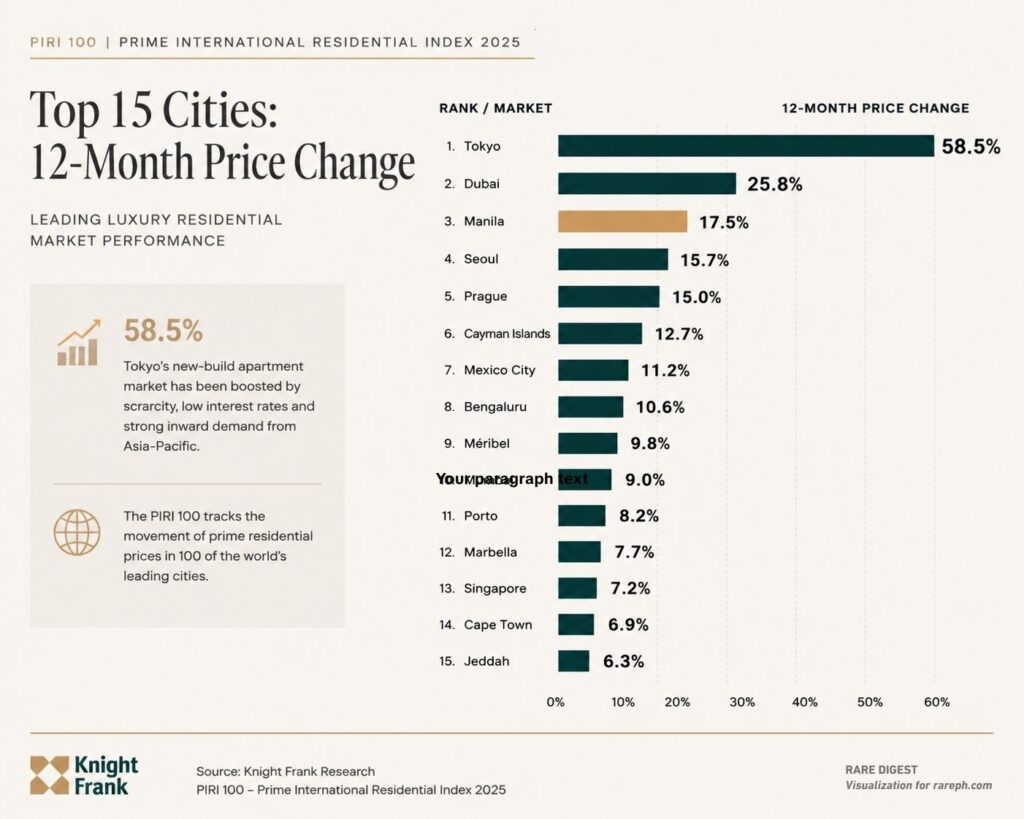
That is a useful indication of how the prime residential market has performed, but it shouldn’t be taken to mean that every property in the Philippines is appreciating at the same rate. Real estate performance varies considerably by location, property type, price point, supply, demand, and the individual property’s quality and positioning.
For a foreign buyer, that distinction matters.
A luxury condominium in Makati or Bonifacio Global City is a very different proposition from a family home in Alabang or a larger residential property along the SLEX corridor. A pre-selling development may suit a buyer with a longer investment horizon, while a completed property may make more sense for someone who wants to move in or start renting the unit immediately.
Rather than treating the Philippines as one large property market, it is worth looking at the individual locations and opportunities that fit your plans.
A good place to start is to explore RARE’s collection of:
This section can be updated as the market changes, while the rest of this guide remains a useful reference for foreign buyers.
ALSO READ: These are Four Localities in Prime Metro Manila Serious Buyers Keep Coming Back To
Let RARE Properties Guide You
Are you moving to the Philippines? Looking for a second home? Buying a condominium for rental income? Looking for a long-term investment? Buying for a family member?
At RARE Properties, we work with buyers looking for residential property across Metro Manila and Southern Luzon. Our role is to help you understand the market, compare your options, negotiate, and coordinate the transaction from start to finish.
You shouldn’t have to become an expert in Philippine real estate before you can buy a home here.
You just need the right people around you.
If you’re considering buying residential property in the Philippines, tell RARE what you’re looking for.
Property availability, market pricing, tax regulations, and developer policies in the Philippines are subject to change without prior notice. While we strive to provide accurate updates, the information in this article does not constitute binding financial, tax, or legal counsel. All transactions should be officially verified and executed through official and accredited channels to ensure full regulatory compliance.